In Islamic architecture, domes are often built over a square or polygonal space using transitional structures such as squinches or pendentives, which allow the circular dome above to connect with the building below. Dome forms also vary considerably across Islamic regions, from rounded Ottoman domes to more pointed and segmented examples found elsewhere.
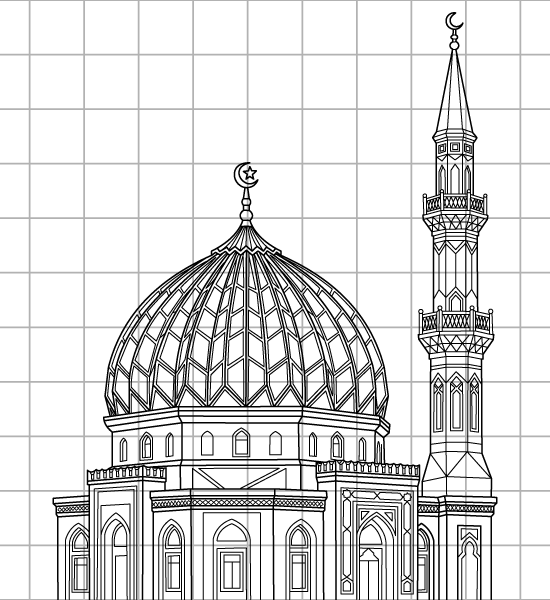
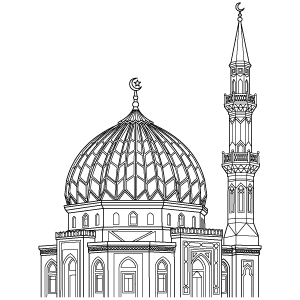
This coloring page focuses specifically on the geometric character of a faceted dome, using repeated angular sections that radiate downward from the crown toward the lower edge. The centered arrangement gives the dome a strong vertical axis, while the repeated facets create a regular rhythm across its curved surface. Rather than relying on ornamental calligraphy or dense tile patterns, this design makes the architectural geometry itself the main feature, allowing the changing planes of the dome to suggest depth through color and shading.
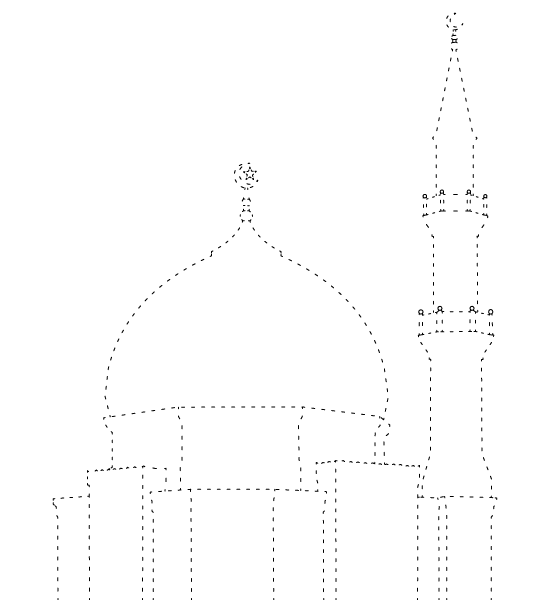
Begin by tracing the basic shapes that form the Faceted Mosque Dome. This tracing page introduces the main outlines of the dome, minaret, and building structure, making it easier to understand the overall design before adding smaller details. Trace each line carefully to build confidence, improve pencil control, and create a solid foundation. When you're finished, continue to the Detail Guide to complete the architectural features.
Mosque Dome Detail Guide
After tracing the basic shapes, use this Detail Guide to complete your Faceted Mosque Dome drawing. Follow the guide to add the geometric panels, windows, arches, decorative patterns, and other architectural details. Work through the illustration one section at a time, using the traced outline as your foundation. This step helps improve observation skills while creating a clean and detailed geometric architectural drawing.
Drawing & Coloring Tip
The repeated facets of this dome make directional shading particularly effective. Start at the central crown and work outward, assigning lighter values to the planes facing your chosen light source and gradually using darker tones on the neighboring facets. Because the sections repeat around the dome, try keeping the same lighting pattern on corresponding areas rather than coloring each facet randomly. This will preserve the architectural symmetry and make the curved dome appear three-dimensional.
For a traditional Islamic architectural palette, turquoise paired with deep cobalt blue reflects colors commonly associated with Persian and Central Asian tilework. Another option is cream, sandstone, and muted terracotta for a more earthy architectural appearance. Deep blue with white or ivory can create the feel of glazed ceramic decoration, while emerald green combined with gold gives the dome a richer ornamental character. Keep the darker shades concentrated toward the lower or less illuminated facets and reserve the brightest tones for the upper surfaces and central ridge areas.
Colored pencils are well suited to this design because they allow you to build several layers of shading without losing the thin geometric divisions. Use smooth, controlled strokes that follow the direction of each facet rather than applying circular scribbling motions. On smooth paper, the repeated narrow sections will remain crisp while gradual color transitions can be built across the larger planes.